Friday, May 20, 2016

Research Paper Prospectus


The cultural artifact that I have found is an image (seen above) from an article from The Atlantic that depicts some of the members the 588th Night Bomber Aviation Regiment (later the 46 Guards Night Bomber Regiment) who were originally apart of  Aviation Group 122. This group consisted of three female units- the 586th(fighter pilots), the 587th(dive bombers), and the 588th(night bombers)- who flew combat missions for the Soviet Union during the course of World War II, what is known in Russia as The Great Patriotic War. The most-known regiment from Aviation Group 122 is the 588th or 46 Guards Night Bomber Regiment, who only flew night missions and where dubbed Nachthexen or "Night Witches" by the Germans. This photograph is highly significant since it reveals that Soviet Russia was the first country to allow for active women participation in the military forces in a time where women where only allowed, and secretly for that matter, to participate in supportive roles in the armed forces. This artifact has been argued to show the light in which Communist Russia wished to present itself to the outside world: that their citizens were superior products of socialism. However, Russian history professor Reina Pennington disagrees that the creation of these female aviation regiments were, as many other historians claim, just a mere propaganda stunt or out of necessity due to lack of male pilots; instead, Pennington believes that famous pre-war navigator & pilot Marina Raskova and her connections in high places (Stalin) allowed an avenue for the creation of the regiments. I agree. Raskova and her individual agency pushed for the creation of one all-female regiment (the 588th) and two all-female navigator and pilot but male-mechanic engineer regiments (the 586 and the 587) that in turn momentarily expanded the boundaries of the so-called "all-male military culture" only to be discharged back into acceptable female occupations due to the idea that women's primary roles were for mothering and nurturing which re-emerged post war due to the Soviet Union's need to rebuild in wake of the war's aftermath. The rise and fall of these female regiments were inextricably linked to the needs of their mother country and what she asked of them: fearless women or nurturing mothers. 


I find that I will need to start contextualizing the significance of these three female regiments by having to start with the flight of the Rodina in 1938; a flight that broke the international straight-line distance by the three women Marina Raskova, Polina Osipenko, and Valentina Grizodubova. The mentioning of other famous female pilots, such as 5-woman aerobatic team based in Tushino Airfield, Moscow all emphasize that while not common, female aviators did exist before the war thus ruling out the argument of necessity; that is that the Soviet Union utilized female combat pilots out of pure need. This in turn brings me to central humanist question I wish to answer: How did the culture of Soviet Union pre-WWII, during WWII, and post-WWII affect the progression and subsequent regression of female occupational advancement within the Russian military forces. To accomplish this I will utilize a gender studies approach as well a historical one to delineate events and understand the underlying values/rationale. 

The bulk of scholarly works on these women primarily focuses around the 588th Night Bomber regiment, also known as the Night Witches, (due to the fact that whenever the Russian press did publish anything on the female pilots they focused on this regiment thus any available information is most about these women ) and takes on different standpoints as to why they were allowed to actively serve in combat positions. Reina Pennington, the leading authority, claims that assemblage of these three primarily female units were done so through the charisma and political backing that fame entails of Marina Raskova, a famous pre-war pilot who help set many aviation records (both solo and in group) and who overtime grew political relationships with Stalin and other members of his cabinet. Geopolitical analyst Mahdi Darius Nazeroaya in his article  "The Historic Role that Soviet Women Played in Defeating the Nazis in World War II" takes on the position that the Bolshevik's ideology (Communism) set the road for women equality as Karl Marx's manifesto demanded by allowing women to enter the industrial workforce and eventually military positions. However, after the integration Nazeoraya fails to answer or attempt to answer the deactivation and overall dismal of Russian military women. A US Air Force report known as "Femme Fatale: An Examination of the Role of Women in Combat and the Policy of Implications for Future American Military Operations" contains a chapter on the WWII Russian women pilots and credits the folklore of Imperial Russia with stories of polianitsy or "women warriors" or sometimes referred to only as the amazonka (Amazon)  having been told to children as fairy tales and thus creating a culture were women could and in certain circumstances (usually the tales centered around invaders and protection of the culture/home) were expected to fight. Nevertheless, the other portion of trustworthy publication on these women are magazine and newspaper articles such as the ones that appeared in The Atlantic , The Los Angeles Times , and The New York Times as response to the death of Nadezhda "Nadia" Popova, one of the better known Night Witches. These articles report on her death and give a brief history of the regiment she served in; nevertheless, their publication years later indicates that as societal and cultural vales have changed that the feats of these women has been allowed to come out and this brings to light the cultural impact that these women themselves had as a comic book, documentary, and film about them have been made by European-affiliated individuals. 

In this research paper I hope to further analyze the impact that culture and societal values can have on the roles of women as well on it can affect historical memory. I believe that my paper will only expand on existing scholarship. 


Sunday, May 15, 2016

Cluster Two

The picture depicts a group of combative women pilots known
as the "Night Witches" with their Polikarpov Po-2 biplanes in the
background.


Reina Pennington  is a professor at Norwich University, a private military university located in Vermont, and teaches military, Russian, and European history. An excerpt titled "Before the War" of her first book Wings, Women, and War: Soviet Airwomen in World War II Combat  delineates a history of women pilots before the start of WW II (in Russia this war is most commonly referred to as The Great Patriotic War). Pennington chronicles their struggle to be accepted into aviation schools, the record breaking flights of the women who persevered -- most famously the Flight of the Rodina (Motherland), a flight undertaken by female pilots Marina Raskova, Polina Osipenko,and Valentina Grizodubova-- and the role that this played in collective mind of the Soviet Union as well as the military implications it had that culturally allowed Stalin to form Aviation Group 122, which encompassed three female fighting groups. The information provided in this chapter will help my research paper greatly into determining what factors (socially, culturally, and politically) of the pre-war period allowed for establishment of the Night Witches during the war. 

An LA Times article titled "Day of Glory for USSRs Night Witches" written by Robyn Dixon in 2001,Dixon is now the Johannesburg chief for the Times, provides information years after the aviation feats performed by the Night Witches. The article covered May 9, 2001's events,  the day that marked the 60 years since Stalin decreed the establishment of the three women air force units. This article not only provided insight into how people in in post-war years continue to celebrate these women, especially since the country they flew to defend no longer exists, but also provided snippets of interviews of the women as they discussed the extremes they would have committed to avoid becoming a POW of Germans. 

A thesis paper written by Captain Beth Ann Myers in 2003 and titled " Soviet and American Airwomen During World War II: A Comparison of their Formation, Treatment, and Dismal" provides an analysis of the similarities and differences of Soviet and American pilots. The evidence given is a synthesis of multiple historical and biographical works in order to understand the different problems women of both societies faced in entering the armed forces, while they served, as well as the lack of recognition that followed post-war. Not only was the information found in this thesis paper helpful for my own paper, but it also provided a page of references to continue the research part of my research paper. 

In 2009, BBC News created an audio slideshow by the simple name of "Night Witches" in which photographs, comic book images, Russian music, and voice-over interviews come together to inform the British audience of the feats of Russian women of WWII while also providing media attention for Irish-born American comic book writer Garth Ennis' meta-series known as Battlefields. The first issue of this comic series was titled "Battlefields: Night Witches." This audio slideshow provided further information into how and why the Russian women pilots would come to be known as "Night Witches" as well as how a contemporary culture has come to recognize and remember the women of years ago. 

Monday, May 9, 2016

Cluster One

Thus far my quest for secondary sources on the so called "Night Witches" has yielded some results, with a downside being that many of them are books written my those within the realm of academia. At this point, I have been unable to find available copies. The articles, military reports, and excerpts of books that I have been able to attain reveal the following picture:

The scholarly conversation surrounding the Soviet Night Witches seems to have an overarching umbrella of women's roles and a amazement of how a perceived ultra-patriarchal society could have allowed for the integration of women into the Russian military while simultaneously citing the Night Witches as a testament of women capability. Historian John Erickson in a short article titled "Night Witches, Snipers, and Laundresses" is at the forefront of giving a historical context for the missions and need for women in the Russian military during WWII. Similarly, Atlantic staff writer Megan Garber gives a brief history of the 588th Night Bomber Regiment in order to provide context and ethos to her American audience in order to convey the celebration of life of female pilot and Night Witch  Nadezhda "Nadia" Popova as she passed on at the age of ninety-one. Unlike the Erickson and Garber who broadly gave historical context, an American Air Force report gave specific details in one chapter titled "The Soviet Women Fliers of World War II" by breaking down the three celebrated all-female fighter units in operation during WWII, their respective missions, and providing some of the better known pilots of each unit. Mahdi Darius Nazeroaya, a geopolitical analyst, provides a sociological lens in his article as he studies Communist ideology, policies of the Soviet government, and significant events of the time to account for the emergence of women in the Russian military, these women referred to sometimes respectfully and other times critically as the "Soviet Amazons." 


Thursday, April 28, 2016

The Night Witches


image taken form Armed Forces History Museum

The Night Witches were three all-female  aviation regiments, one of the most notorious one being the 588th Night Bomber Regiment, of the Soviet Union during WWII. They were labeled "Night Witches" by the Germans because of two main reasons:

  1. they only attacked at night
  2. and the sound of their planes (Polikarpov Pro-2s) allegedly sounded like a witch's broomstick to the Germans (NPR- Night Witch Flew Bomber Planes During World War II).
 These regiments, these women their stories, and the fact that they were told to withhold their stories will be the focus of my research project. 

I suppose I will be approaching this topic with a sociological and perhaps even psychological academic lens. At some other points I might try compiling answers through a linguistic disciplinary approach (the term "witches" is at the forefront of my mind). 

The types of question I wish to attempt to answer are along the following lines:

  • What was the thought process behind of implementing female regiments in what most Americans believed to be a backwards and barbaric country (the Soviet Union)  when other 'progressive' countries would not even attempt to have active female units until years later?
  • Why the label "witches"?
  • What cultural forces/ beliefs were in play when after their service, these women were asked not to talk about their missions?

Monday, April 25, 2016

Possible Research Artifacts

In a past lecture, titled "Women in the Military"presented by Professor Carol Burke two pictures were presented side by side. These two images were Michelangelo's Isaiah and Rockwell Rosie. 


Image was taken from Professor Burke's lecture slides. 

When I saw these two works of art I was immediately surprised and intrigued. The character Rosie the Riveter, Rockwell's illustrated World War II character, often championed as a symbol of women's strength, independence, and ability was fashioned on an image of a man. I find this incredibly fascinating and I believe this might need further investigation. 

Another possible artifact would be the evolution of weapons, specifically the gas chamber. I understand the gas chambers have been used in the past to execute condemned prisoners and most notorious were in operation in concentration camps in the Holocaust. The gas chamber is something that caught my interest because while I was interviewing my high school JROTC teacher we focused in on his time in basic training. I asked him what was one thing he didn't like doing and he answered going into the gas chamber. The armed services has a course in which recruits must go into a gas chamber without any protective gear(masks) and try to withstand the ordeal.

Another possible artifact would be an instructional video from the Cold War era. I think it would interesting to find out who produced these instructional videos and where they where shown. Today, at any given moment (as long as WiFi is available) a person can access a video, movie, episode from their phone, computer, and other electronic devices. This was not the case in the 1950-1980s. 


Sunday, April 3, 2016

Choosing an Interviewee

When first given this assignment of interviewing someone with some connection to a war, I immediately flash backed to those Family Tree projects in which you had to research your genealogy and create some nice graphic delineating your finds.

What I mostly remember of those projects was that my parents had little to tell me. I knew my grandparents' names and only the first names of my great-grandparents. That is as far as I ever learned of my family history. My family just does not keep records. 

So when I heard we had to interview someone in connection to a war, I panicked. Who was I suppose to interview? No one in my family had connections to war or the military. 

After some initial moments of panic, I remembered that while no one in my family had a connection to war/ the military I did know at least two people who did. These persons were my high school's U.S. Army Junior Reserve Officer Training Corps (J.R.O.T.C) Instructors: Major Frederick Merz and First Sergeant Marvin Herbert. 

This picture was taken at my Senior Awards Night.
Major Merz is pictured at the right end holding a manila envelope.
First Sergeant Herbert pictured is at the left end . In between, in uniform,
are Let III cadets who were part of the Color Guard that night.  

These two men were not only my instructors for four years, but my mentors. I have already contacted both by email and both are willing to be interviewed.

As this assignment [the literary journalism project] continues, I hope to learn more about my past-instructors. I knew that First Sergeant was a Jumpmaster during his time in the military and that Major  held a staff position in a brigade (a brigade has five main staff members that work directly with the Brigade Commander, each staff member has his or her own assistants) during his time.  I never really pried into their past military lives (I was mostly concerned with not being chewed out or fired from my own staff position during the time I knew them) because I wanted to respect their privacy. However, with this assignment it seems I will have no choice but to delve into their pasts. I can only hope that they will be forthcoming with their stories. 

Friday, March 4, 2016

Reflections


In the course of two quarters, this blog has evolved from  making connections from one literary piece to another to connecting what I was being taught in Humanities Core and my Criminology course and noticing that these two disciplines discuss the same questions with different methods.

The School of Humanities approaches their area of expertise with the intent of giving others an interpretive perspective of texts and artifacts in order to provide a glimpse of a culture or time in history. The School of Social Ecology, in which the Criminology discipline falls under, approaches their studies in the gathering of data and statistics to prove hypotheses and advise other people and institutions on how to approach their problems, they provide a glimpse into our current culture and society. Essentially, in my mind, they are the opposite sides of the same coin: one gathers qualitative information (Humanities) and the other quantitative information (Social Ecology). 


With that being said, while I was able to merge ideas from both disciplines to create the second half of this blog (Winter Quarter) I also realize that I did not represent both schools equally and thus effectively, my original goal back in January. With an approaching research paper in the months to come, I hope to be able to apply both of these disciplines (my majors of English and Criminology) and do them both justice. With the two different approaches taught to me, I endeavor to give both qualitative and quantitative information on current, and may I venture to say deeply rooted in the past, societal issues. 

I hope to focus on the U.S. military and possible topics to pursue in the spring may include:

  • Media portrayal of troops: the evolution of still media, such as photographs and illustrations, to moving media, video and film, and how these types of media present soldiers and war 
  • The history of people of color in the military and possible lack of opportunities as visible in other areas of American life
  • The conditioning of American soldiers through the use of "torture-tainment" to decrease emotional and moral reactions in order to complete the task at hand: emerging from the War of Terror as the victors. 

In the end, whatever the topic of the research paper, I hope to continue to combine my two majors and further participate in the discussion of our time: The nature of War and all of that which it encompasses. 


Friday, February 19, 2016

Torture-tainment & Desensitization

We live in an age of technology.  And while technology has given us many advantages it has also taken something from us: our ability to recognize and react to violence.

As advances in technology have been achieved, society as a whole has regressed. I attribute this to the amount of free time the average American now has at his or her disposal. Technology, in my mind, is inherently linked to machines. As machines have developed they have taken on both menial and labor-intensive occupations that people are now free from performing. This freedom is mostly spent in attending to visual medias such as television and films. And here is where the desensitization comes in.

Television programs and films have increased the amount of Torture-tainment, a genre of visual media in which acts and moments of torture are depicted, in their content.  This constant exposure to violent scenes leads to a diminishing emotional response in those who watch and even to a lack of recognition that an act that violates human rights has taken place.  

The Hunger Games, both a book trilogy and a four film franchise, has been read and watched by hundreds of people. Its main target audience is adolescents.  At first glance, The Hunger Games seems to follow the protagonist Katniss Everdeen as she enters a life or death situation in lieu of her sister which in turn sets off a catalyst of reactions that end up with the oppressed people of The Hunger Games world to rise up against its government, the Capitol. 

With this rudimentary understanding, The Hunger Games appears to be a narrative of Good triumphing over Evil with overtones of Love conquering all. However, what most people gloss over is the methods that the Capitol used to maintain control: torture. Viewers and readers recognize that the government of The Hunger Games is not a functioning one, they categorize it in terms of tyranny and abuse of power. What they don't see or overlook is the systematic killings of 23 youths with one forced-killer surviving the genocide, often with psychological trauma. 

New Yorker staff writer Amy Davidson likens The Hunger Games to a story of counterinsurgency and wonders whether its popularity is stemmed from America's involvement in multiple wars. This not only speaks to a desensitization of torture but also a demand for violence by the public. 


This desensitization to violence is not a new idea. It can be traced back to the 1970s to German-American novelist Kurt Vonnegut and the publication of his book Slaughterhouse-Five (1969). Through this book Vonnegut published his concerns of society failing to react to images of mass death and violation of human rights that filled the newspapers and filled the television screens during the duration of the Korean and Vietnam Wars. Vonnegut himself was a veteran of World War II. 

Vonnegut may have been advocating for society to recognize its worrisome relationship with acts of violence and degradation of the human body in the early 70s, but it appears that society took no heed. With major blockbuster films such as Zero Dark Thirty (2012) and Deadpool (2015) America's relationship with violence, and by extension torture, appears to be stronger than ever. 

What does it say for the future of America that its most seen films and television shows are constantly screening images of torture- an act that demeans the human body?  

Friday, February 5, 2016

Enhanced Interrogation Techniques and Police Misconduct: Different Matters or Related?


For the purposes of this blog entry I want to define torture as "the infliction of severe bodily pain, as punishment or a means of persuasion" (OED). 

During Professor Lazo's lecture I learned about different euphemisms for torture ("special methods of questioning" and "refined interrogation") as well as how and why those who use methods of torture justify their use. Professor Lazo focused on CIA operatives and military personnel who worked in Guantanamo Bay and other black sites to combat "the War on Terror." Those operating against labeled "terrorists" used a scenario known as "The Ticking-Time Bomb" as justification for their actions. This scenario includes gathering information from a captive terrorist who may have knowledge about other attacks that have yet to be conducted by the terrorist group they align themselves with. In such a position, interrogators claim they need to apply "moderate physical pressure" in order to prevent the loss of large quantities of life. 

While learning about the standardized methods of torture the United States enacted on its incarcerated international detainees I was learning in another class of similar instances here within the the country's borders: police and tortured confessions.   While reading the chapter "Freely and Voluntary" from Steve Bogira's book Courtroom 302: A Year Behind the Scenes in an American Criminal Courthouse I came across instances of Chicago law enforcement officers using "coercion" on suspects of murder cases in the 1980s.  In an inquiry conducted by Cook County police department's Office of Professional Standards, defendants were found to be "bagged" or suffocated with plastic bags or electroshocked with the machine's clips being placed anywhere from the ears to the genitalia(175-177).  

David H. Bayley, a Dean and Professor at the School of Criminal Justice at the State University of New York examines police rational in law breaking in an article titled "Law Enforcement and the Rule of Law: Is There a Tradeoff?" In this article Bayley asserts that public safety and career success has a lot to do with it. "Police see the raw hurt that criminality inflicts" and are tempted to violate the rule of law in order to attain "speedy justice" (139). The  police system is also a reward-based one in which the higher number of cases "solved" equates to medals and promotions; in order to meet certain quotas officers found themselves breaking the rule of law and justifying their actions by claiming to work  for the "greater good." 

Not only are these two institutions charged with enforcing law and protecting United State citizens (one from dangers abroad and one from domestic dangers), they also seem to find torture a preferred method for extracting confessions. They also both claim to be saving lives and preventing situations where lives can be potentially put at risk. 

Now here come the moral dilemmas: 
  • Is it right for the lives of some to be endangered to potentially save the lives of many?
  • Do the ends really justify the means?


Many who are against "enhanced the interrogation techniques" used by the CIA argue that when someone is under extreme physical duress, they will begin to confess anything and everything the interrogator(s) want to hear. Similarly, police officers in Cook County , Chicago in the 1980s received the murder confessions they wanted to hear to close a case. However, in the 1990s these "confessions" would come back to haunt officers as defendants began to speak about the beatings, suffocations , electroshocks, and threats that pressured them into giving falsified confessions. 

Bayley in the same article that examined police justifications for law breaking also listed the disadvantages of police lawbreaking. Some of the points he made were that violating the rule of law :

  1. Contributes marginally to crime deterrence
  2. Reduces enforcement effectiveness
  3. Weakens the authority of the law
  4. Scapegoats the police
  5. Wastes community resources (142-145). 
While what Bayley wrote about was specifically police officers, I would go so far as to attribute these to organizations such as the CIA because these institutions have become more and more militarized. These militarization is perhaps the problem. I feel that many Americans are worrying about what we as the United States have done to (or not done) to international detainees; perhaps we also need to direct our vision inward and examine what our criminal justice system is doing to its own citizens. 


Friday, January 15, 2016

Realizing How Information is Presented to You

Becoming eighteen  in the United States not only comes with the responsibility of being perceived as a full fledged "adult" under the eyes of the law, but also with a present from the government: the eligibility to vote. Now I know for some young men and women of this age, the right to vote does not seem like an awing event. I do. 

I find the idea of being trusted enough by my government to have a say in what they do amazing. Not only that, but I take into account all of the men and women who made this event possible. I am a young woman of color that can vote. That can make her voice be heard, along with countless others, about how the institutions of her state and federal governments should be run. 

Having registered to vote and realizing how I can make a difference has put me on alert to the upcoming presidential election and how news and information about the potential presidential candidates is presented to me. This brings me to what I want to talk about today: primary and secondary sources. 


What exactly is a primary source? 

A primary source, in regards to humanities subject of study, is either the original account or an account made soon after an event. 

To begin my search of understanding of today's politics and issues, I went to the center of the Unites States' political center: Washington D.C. 

I watched President Obama's Final State of the Union Address in order to gain a feel of where America and her politics are at the moment. From watching this address, I came to learn that President Obama intends to focus on four aspects in his time remaining in office:
  1. A New Economy that Works for All
  2. The Spirit of Innovation
  3. U.S. Leadership in the World
  4. A Politics of Hope
For any who wish to hear the address or learn more themselves about President Obama's intentions, they can watch the address HERE. 


A secondary source is a second hand account of an event, usually with an interpretive or analytical lens. 

I participated in hearing what  secondary sources had to say about the political future of the United States through a debate series held at the University of California in Irvine titled "Which Presidential Candidate is Best for the U.S.?" In this debate, four teams of two answered questions about the candidates (Hillary Clinton, Bernie Sanders, Marco Rubio, and Rand Paul) they believe should be the next president. 

Since the four candidates where not actually there in person to debate, the answers I was hearing where interpretive responses made about the candidates as perceived by the college students. 

Beginning to dive into the political debates and information about political figures, I am starting to critically analyze where I receive my information.  Whether it is a primary or secondary source of information and who exactly is presenting it. 


Friday, January 8, 2016

The Negative Perception of African-Americans: From Civil War to Modern Times

While doing some of the reading for my "Introduction to Criminology" course, I came across many instances in which there was a negative treatment of African Americans by Whites. These instances when read after Narrative of the Life of Frederick Douglass, An American Slave lead me to ponder the idea of  1800s racism having trickled down into our modern day justice system. 

The period of time in which the United States allowed the institution of slavery to materialize and flourish has been often referred to me as a "blotch in our nation's history" by multiple middle school  and high school teachers. Through Douglass's narrative, readers receive a first hand account of the actions and brutality in which slaves where oppressed and dehumanized. Similarly, in Steve Bogira's Courtroom 302: A Year Behind The Scenes In An American Criminal Courthouse a reader ascertains knowledge of behind the scenes happenings in a court room that includes the treatment of those arrested by  the deputies on duty and the perceptions that a judge, prosecutors, and public defenders have of those alleged with crimes and vise versa.  


In this blog post I want to try and make a connection about how systems of institutions have failed and in some instances even worked against African Americans and  other people of color. 

During Douglass's era, laws such as the Fugitive Slave Act of 1850 deliberately worked against those who wanted to escape the bondage of slavery. Due to this act, Douglass sees a rise of "legalized kidnappers" who deceive runaway slaves into believing they were good Samaritans who could aid them in their time of need but instead ended up returning them into slavery while making a profit (Narrative, pg 101). While Douglass fiercely advocated for the complete freedoms for his fellow African-Americans, it seemed that he and his fellow brethren traded one set of problems for another. This is illustrated in the picture below titled "The Union as it Was: A lost cause, Worse than Slavery." 


"The Union as it Was: The Lost Cause, Worse than Slavery"
Illustrated in Harper's Weekly.
Created by Thomas Nast.


The illustration depicts a "White League" man, a paramilitary group that arose in the 1870s that tried to turn out Republicans from office and stop recently-free slaves from voting and becoming politically organized, shaking hands with a Klu Klux Klan member. Below the handshake, is an African-American family huddling in positions that indicate fear. Behind them in the left hand corner of the space the couple encompasses is a man hanging from a tree. On the right there are remnants of a burned down school house that hint of the obstacles that slaves would still have to contend with on their road to equalize themselves with their lighter-skinned counterparts. An equality that I believe has not seen in our modern-day court system in which justice and fairness should be the prevailing outcomes. 

The African American couple appears to be within a badge-like frame. The top of this frame is bordered with a skull and cross-bones image that is reminiscent of the infamous Jolly Roger flag iconography that is associated with pirates. Above the handshake of the two white men, is an eagle with the inscription "This is a white man's government." The eagle is a symbol of the American government and the inscription conveys that people of color would not find true freedom and equality under their current government. 

Reading Courtroom 302, I have come across further belittlement of African Americans. Prosecutors of the courthouse in Chicago once had a contest in which the goal was to "convict four thousand pounds of defendants" (Bogira, pg 69). This contest was known as the "Two-Ton Contest" and later on renamed the "Niggers by the Pound" after most of the convicted turned out to be African American.  

While we as a nation have come a long way in terms of physically freeing those who were once considered property, I believe we have failed in terms of giving them equal opportunities under the law. While they may no longer have to call someone "master," discrimination towards them has not ceased. The negative perception of people of color that continues to persist no matter how many young men and women attend institutions of higher education and try to change the reputation that follows them, makes me wonder if discrimination can ever be eradicated. Can we really look past the color of a person's skin and see the human being?


Sunday, November 8, 2015

Initial Thoughts on Machiavelli's "The Prince"

Niccolo Machivelli's The Prince
Translation by William J. Connell

When I first saw that Machiavelli's The Prince was one of the books required for the Humanities Core class, I was actually kind of excited. This book has been on my to-be-read pile for awhile now; since about junior year in high school, actually. 

It was during that year of high school, that my AP Language teacher assigned each student a topic to research and to present a 5 to 7 minute power point presentation. My topic was Machiavelli. Because of this, I had some prior background knowledge on Machiavelli, his political and social status around the time he wrote this book. That being said, that is all I had. My high school self spoke 7 minutes on Machiavelli, his social standing, his book The Prince, and some of his ideologies but could not be bothered to actually read his most known work. 

Now that I am required to read it I must say this: it is a tough read. Now the translation is easy enough to understand, the tough part is wrapping my mind around his [Machiavelli's] concepts. However, when I do come across some of the points I presented in high school such as the infamous question "Is it better to be feared or loved?" I find a wave of new energy come over me and I try to read The Prince more diligently. 

I suppose the reason I am slowly making my way through the text is because I cannot connect to the history. I am not extremely knowledgeable of all the historical and political figures that were prominent during Machiavelli's time  (thank goodness for those footnotes!). I understand the want a prince may have for growing his empire or why a lord might want to become a prince. I even understand why having troops of one's one would be better in the grand scheme of things than having mercenary arms (hired soldiers). I am just finding it difficult in making a connection between myself and the message of the book. 

I have often thought that people's tones and intentions come across differently through just plain text (i.e. a letter, a book, on a screen such as a text or website) than when they are actually in your presence speaking to you. I did not know Niccolo Machiavelli when he was alive and have no idea how he would have spoken the ideas in his book. All I have is the book. 

Machiavelli is so straight forward in his composition that he does come across as harsh at times. I understand why at the time of its publication this book was so controversial, why it was banned years later, and why Machiavelli gained an unfavorable reputation. However, I also recognize that the content of the book itself is adequate advice. The advice is just stripped of emotion and is all business. 

And ultimately, I think the book is exactly just that: Business. The business of taking over other states, expanding an empire, or on how to gain and maintain control. 

I encourage (if you haven't read it already) to pick it up and read it. I would love to hear what you all think of it and what kind of book it strikes you as. I know I will be returning to it to try and find more meaning within its pages. 


Sunday, November 1, 2015

Anti-war Literature

Over the past few weeks in my Humanities Core Course, I have attended lectures with topics being the ancient epic war of the Trojan War, the Thirty Years' War of 17th century Europe, and lately World War II. During one of Professor Smith's, a professor specializing in German studies,  lectures he played a small part of a larger video. A particular image in this video resonated with me. 


City of Dresden after massive bombing.


The image was of the city of Dresden, in the aftermath of a bombing attack. This image- this city rekindled memories of my AP English Literature class from high school. The first time I encountered the bombing of this German city was through  the novelist Kurt Vonnegut and his anti-war novel titled Slaughterhouse-Five or The Children's Crusade: A Duty Dance with Death. 

A year ago (around this time of year in fact) I read an anti-war novel. This year, I have read an anti-war play.While one was meant to be read and another watched, both of the writers' aims were the same: to challenge the masses and inspire collective action. 

Bertolt Brecht, the playwright of Mother Courage and her Children, was born in Germany in 1898. He wrote this particular play at a point in his life where he had fled Germany because: 
  1. Hitler had risen to power
  2. he was left-winged intellectual (believed in some aspects of Communism)
Being exiled from all you know, all that is dear to you is no easy feat. This play has (for all that Brecht tried to keep emotion out of it) tones of loss and despair. This play has been described by actress Meryl Streep as "a cry"; a cry of asking "why?" This question, however, is not part of the question "why me?" but rather "why did we let it get to this?" Brecht's play is a representation of what war is like. There is no heroism in Brecht's representation of war and there is no crushing sorrow (that is supposed to felt), there is just War. 

Kurt Vonnegut,a novelist, was an American with German ancestral roots. He fought during World War II for the Allies, was taken as a prisoner of war by the Germans, and witnessed the bombing of Dresden. The significance of the bombing of this particular city was the fact that it was purely civilian and had no fortification, no armaments to attack and defend from enemies.  It was full of women, children, those injured by the war, those too old to fight in the war, and prisoners of war. Beginning of February 13, 1915 and ending on the February 15th, Dresden was bombed by the Allied forces. 

Living though this, Vonnegut came home and had the seed of an idea for an anti-war novel. This novel may have had its roots in World War II, but it did not become a reality until the Vietnam War was well underway.  His anti-war novel, or as he liked to think of it his "anti-glacier" novel undertook the task of not recounting the horrors of war, but of pointing out the blasé attitude of the masses in times of war. 

Vonnegut felt that the American people had become desensitized to  the violence of war. During the Vietnam war, it became a standard practice to give a toll of the number of dead each night during the news. Death toll numbers, images of massacres became the norm and the violence of war was no longer monstrous or inhumane. 

By reading the novel Slaughterhouse-five I learned that the opposite of love was not hate, but rather indifference. Love and Hate are both strong emotions, they are essentially the two different sides of the same coin. Their counterpart is indifference; the lack of caring is the true horror of the generations that have followed Vonnegut's. 

What I found to be so profound in both Brecht's and Vonnegut's work was the way in which they approached the topic of war. Both of the works I discussed are considered "anti-war" yet these two men did not simply state or show that war is bad (a thought I believe, we all know deep down by our innate instincts that is true). Vonnegut attached the term "anti-glacier" for his novel since he believed "There [will] always be wars...they [are] as easy to stop as glaciers" -and we all know how the confrontation between a glacier and the Titanic went (Slaughterhouse-five. 1. 3).  However, what these writers attacked was not the evilness of war but the actions or lack of actions taken beforehand. What they aimed to inspire was collective action. 

One person alone is not enough to change the world. It is when people come together as one in action and thought that change can be accomplished. 

Personally, I know that I am too detached from war and its violence. I know many wars have started, ended, and some are still continuing in my life time. Yet, my life has been a good one. I have, or at least I believe, not been severely affected by War. The only experience I have with the military was through the Junior Reserve Officer Training Corps (JROTC) program at my school. And when I really think about it, but I mean pause and really think, I become ashamed. I reap the benefits of another person's labor, a person who is away from home because of a war. Then I ponder what I should do. Should I become involved? Should I join the military (my JROTC instructors believed I could have been an Officer)? Should I protest war?  

I don't really know what I should do. I am still figuring it out. I am just glad I have had teachers and professors who have introduced me to works such as Slaughterhouse-five and Mother Courage. For jolting me awake from my own apparent apathy towards War; for making me realize that something must be done. 


Sources


  • Slaughterhouse-five
      Vonnegut, Kurt. Slaughterhouse-five or the Children's Crusade:       A Duty Dance with Death. New York: Delacorte                       Press/Seymour Lawrence, 1991. 


Saturday, October 24, 2015

War and its Mediation


Today I want to talk about viewpoint, mediation, and manipulation. 

When it comes to War, not many of us are there in person to witness and experience all that happens in a war zone or the surrounding areas of the said war zone. For information of this kind we rely on the media. 

When I say "media" I mean journalists, reporters, newspapers, and social media such as Facebook and Twitter. And the media, being the media, has a tendency to mediate events or stories in order to draw out a certain reaction or nudge the general public into a certain kind of action. However, I would like to claim that the act of mediation is not just committed by those who work within the media. 

We as humans have a innate talent in mediating what we see or hear to convey our viewpoints onto others. I know we do this, because I myself can recall multiple times in which I have mediated things said to me. The instance that I can immediately recall is when I worked as a translator for my father's business. 

My father owns a landscaping business. While he can understand the English language when spoken, he himself is limited in conversing in English. This is where I come in: when it came to talking to clients both my father, the client, and I would set up an appointment in which I translated for both client and service provider. My father's mode of speaking becomes very repetitive when he is trying to make a point, because of this I often mediated his speech to the client so that my father's side of the conversation was more straight to the point and clear cut. 

Because of my own experiences in mediating conversations, I understand how easy it really is to manipulate other's words, images, videos, etc. And war is a huge issue that is often mediated.

At the beginning of this post there is a picture in which the original whole picture is in the middle with cropped versions of it flanking its sides. On the left there is a soldier held at gunpoint. This version of the image shows the violence of war and the lack of mercy. The version on the right is its counterpart. Here a soldier is giving another exhausted soldier water. Here the image connotes comradery and care. What the whole image essentially shows is how war images and videos can be manipulated by those who present them. This then brings me to viewpoint. 

Images, videos, an the news are presented to us in certain ways. They are either meant to call us to action, contemplate the actions of our leaders, criticize a course of action, etc. 

In war time, the most common form of media in circulation is propaganda. Propaganda is most commonly presented by the government at war or the military. Since the government and military are the source of this type of media, they present war in a light were it is necessary, heroic, and honorable. 

This viewpoint is quite different than that of those under siege. 

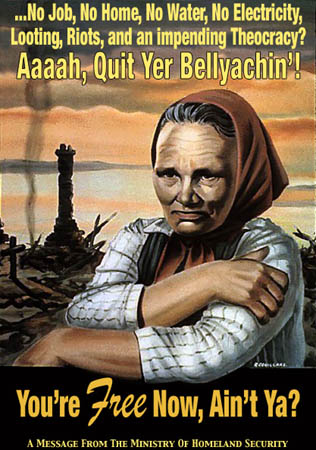
This poster was in circulation during
the time of Soviet Russia. Its aim was to
show the unification of man, woman, state,
and military under Communism.
Critique on how the United States may be
causing more harm than good with all
the "foreign" wars it has participated in. 

Here there is no majesty of war. Presented is the devastation that war can cause. 

The media is great at delivering only part of a story. They take a whole issue and present only facets of it. They may choose to show the horrific, the patriotic, the redeemable. It is up to us as the viewers and the audience to question and think critically; to seek out as much of the story as possible and decide for ourselves how to feel and how to act. 


Sources


Friday, October 9, 2015

Homeric Women: Powerful or Not?

 In the text The Iliad, women are seen to have little free will (unless they are goddesses). They are objectified into prizes. This objectification is seen early on in the epic, as early as Book One when king Agamemnon professes to Achilles "I will be there in person at your tents/ to take Briseis in all her beauty, your own prize"( 1. 217-18). Thus far The Iliad seems to represent the accepted universal truth of early civilization: women are second in respect to man. 

This past Friday, a forum presented by Professor Karanika of the Department of Classics, revealed to me that Homeric women had much more power  than I initially perceived. 


 Marvel's Illustrated: The Iliad issue #1


While it is true that Homeric women are seen as prizes, as status symbols for the man whom she belongs to, they also wield a tremendous amount of power that even they may not have been aware of. 

Two women that must be mentioned first include Helen, wife of Greek king Menelaus now coupling with Paris of Troy, and Briseis, Achilles' won consort taken by king Agamemnon. The power these two women wield is the power endowed to them by beauty (Karanika). 

Helen is acclaimed to be the most beautiful mortal woman alive for whom "the men of Troy and Argives under arms have suffered / years of agony for her" (3. 188-9). Her beauty gave her the power to initiate a ten year long war in which countless people, young and old, found their lives forfeited to the God of Death. 

Similarly, Briseis' power also relies upon woman's beauty. Her power was the brief relief the Trojans see in battle since Achilles became enraged with Agamemnon and refused to aid the Achaean war effort. Briseis, even though she is a spoil of war, was a trigger in the major losses of Achaean life. 

Ordinary women also wielded a power the ancient heroes did not possess.  Homeric women had the power to immortalize a hero. 

Professor Karanika made evident, through contextual evidence, that Homeric women have a voice only when working, praying, performing a ritual, or lamenting. These acts is what make male glory.

When a hero dies, it is a woman's lamentation that memorializes their heroic deeds. Lamentation can even be seen before a hero's death as Thetis demonstrates, " O my child!/ Yes, I gave birth to a flawless, mighty son.../the splendor of heroes" (18. 63-5). Henceforth, Achilles, the son spoken about in the outburst, will be known and attributed with characteristics of splendor and might. 

Homeric women also exhibited power in the circles of prayer and rituals for prayer. The right offering and profusion of adequate words given by a woman or group of women could save a life, a city, a culture, or it could foretell doom.  An instance such as this seen in The Iliad is the gathering of Troy women who pray to the Goddess Athena:
"lifting the [Sidonian] robe on high/ ... [they] prayed to the daughter of mighty Father Zeus:/ "Queen Athena- shield of our city- glory of goddesses!/ Now shatter the spear of Diomedes!...." (6. 357-361). 
The collective prayer of the women above is an instance were their power and their lack of correct use sealed the fate of Troy. While the prayer itself might have been pleasing to the goddess Athena, the improper ritualistic rite was not. While ritual in prayer dictated an offering (which these women certainly provided- i.e. the robe) they were incorrect in using that specific offering since it was not made by Trojan hands but by Sidonian enslaved hands. This technicality was what  invalidated the women's prayer and in the long run cost them their freedom and their husbands and sons' lives (Karanika). 

Most modern women today continue to pursue gender equality since they believe their predecessors lacked it. While most women of the past may not have enjoyed many of the freedoms today's women enjoy, I would not count them out in terms of influence and power. They certainly had their share of it if The Iliad is believed to be a historical reference to actual past events. 


Works Cited

Fagles, Robert, trans. The Iliad. By Homer. Penguins Books: New York, 1990

Comxicology. 9 October 2015. Gamma Radiation. 9 October 2015. 

Karanika, Andromache. "Friday Forum." The War Prayer: Women's Rituals in the Iliad. Biological Sciences III, Lecture Hall 1200, University of California, Irvine. 2 October 2015. 


Friday, October 2, 2015

An Introduction to the Humanities and Homer's Iliad

Hello Fellow Humans, 

Welcome to my blog. To find out more about who I am and what perspective I am tackling the topic of War CLICK HERE or look to the right side of the blog, look under "Pages," and click the page titled "About Me and this Blog." 


An Introduction to the Humanities  

 Humanities is the study of how humans "[create] meaning through their thoughts, their actions, and their creations" ( Handbook, Pan, pg 5). This definition , as you can see, is a by-the-book definition and when I first read it had little meaning for me. This was troublesome for me at the time since at this point in my collegiate career I was only a Criminology major and considering the addition of another  major (English) which fell under the School of Humanities. 

Soon afterwards, the Humanities was explained to me by discussion leader as "the study of qualitative date versus the compilation of quantitative data" ( Dickmeyer). In other words: the Humanities concerns itself less with compilation of numbers and instead focus the brunt of its powers to the interpretation of texts and artifacts that allows us to peer into a culture, or time period that is or has existed at a different time than ours and allows to extract what is relevant to our society, culture, time period.   

With this idea of the Humanities in mind, I knew had made a good choice for myself in signing up for the Humanities Core Course. 

An Introduction Into the Iliad 

Cover design above is credited
 to Gail Belenson.  This translation
of the Iliad is by Robert Fagles. 


The first work assigned in this Humanities course was Homer's The Iliad. Having read one of Homer's other works, The Odyssey, I was excited and had an idea of what to expect concerning language and form.  

For those of you who are not acquainted with Homer, his poems fall under the genre of the Epic.

Elements that identify an epic poem  include:
  1. "a long narrative poem of heroic action
  2. written with the use of elevated language 
  3. has foundational significance for the culture in which it originates from " ( Izenberg). 
The Iliad is a text that is over three thousand years old. Its original language, Ancient Homeric Greek, is now identified as a "dead language." 

Homer's Iliad, as it has been handed down to us in its current form through many translations, is an epic about the ninth year of a ten year war between the Trojans and the Greeks. The spark that ignited such a costly war was the Trojan Prince Paris' abduction of a Greek woman named Helen. Helen was a lavishly beautiful woman who was the wife of Menelaus , "the younger king of Mycenaean Sparta" (Wikipedia). The main story of The Iliad, however, is not the start of the war but rather nearer to its finish and the conflict that arises between two Greeks, Achilles and Agamemnon, and how their actions or lack of action affect the war effort. 

My own thoughts into the work are as follows:

  • How much content was lost or retained during all of the many translation there are for the Iliad?
  • Why focus on the spat between two Greek warriors when the war is between the Greek and Trojan people?
Until next time, think like a Humanist! 


Works Cited

Fagles, Robert, trans. The Iliad. By Homer. Penguins Books: New York, 1990

Pan, David. "What are the Humanities?" Ed. Larisa Castillo. Boston: Pearson Learning Solutions, 2014. 

Izenberg, Oren. "Humanities Core Lecture" The Iliad and the Meaning of the Humanities. Biological Sciences III, Lectural Hall 1200, University of California, Irvine. 28 September 2015.  

Dickmeyer, Laurie. "Humanities Core Seminar". Donald Bren Hall, Room 1429, University of California, Irvine. 28 September 2015.